
The grass has gone brown across most of Texas, and the feed truck is about to become a regular sight. Before you order the same load of cubes you bought last year, a recent article in American Cattlemen is worth ten minutes of your time. In “Supplement Advantages,” writer Heather Smith Thomas talks with ranchers, nutritionists and university specialists about when cows need a supplement, what kind, and how to keep from overpaying for it.
What the article says
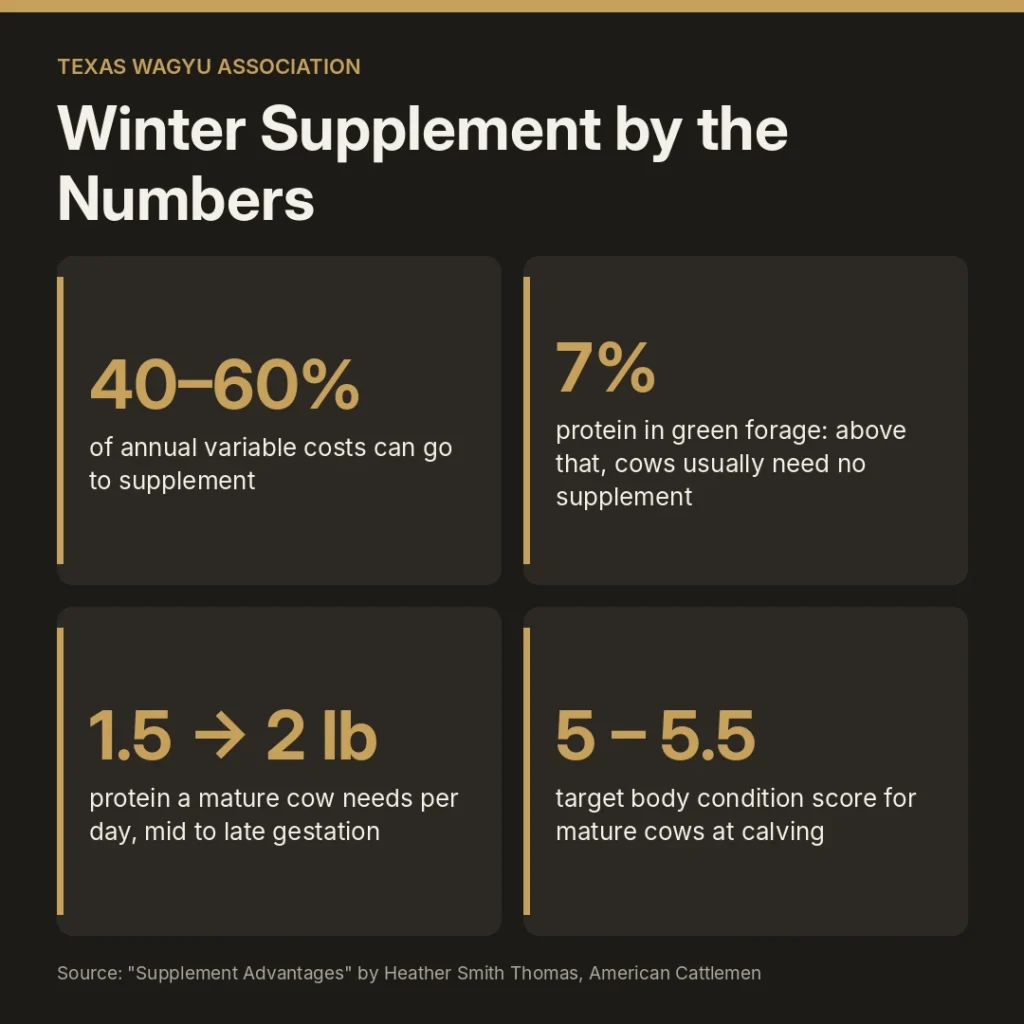
The short version: feed what the forage is missing and nothing more. Rick Machen, formerly of the King Ranch Institute for Ranch Management, is the one who puts supplement at 40 to 60 percent of annual variable costs. He also points out that cows on green forage testing above 7 percent protein usually don’t need any help at all.
From there, Thomas walks through how a cow’s protein needs climb as her pregnancy moves along, how often you really have to feed, and how to compare products on what the protein costs instead of what the bag costs. Several of her sources come back to the same habit: watch body condition and let the cows tell you how the program is working.
Why it matters in a Wagyu herd
The calf is worth protecting. A Wagyu calf, and especially a fullblood or an embryo calf, carries a lot of money and years of breeding decisions. In the article, University of Nebraska beef specialist Mary Drewnoski notes that a cow shorted on protein during gestation can affect how her calf develops over the long haul. For a breed built on what happens at the rail, that’s a risk worth taking seriously.
Young cows need the most attention. Drewnoski says mature dry cows grazing cornstalks may get by without supplement, while first-calf heifers may need up to 3.5 pounds of distillers a day. We’d add the recipient cows many of our members rely on to that watch list. They’re doing the heavy lifting for your best genetics.
Body condition is your breed-back insurance. Janna Block of New Generation Supplements recommends that mature cows calve at a body condition score of 5 to 5.5. She calls weaning a good time to take stock, especially of thin cows and young cows. If you weaned this fall and haven’t put a score on your cows yet, now’s the time.
Smaller herds feel every feed bill. Plenty of TWA members run smaller herds and buy feed by the pallet, not the truckload. Jeremy Martin of Great Plains Livestock Consulting says to compare supplements by cost per unit of crude protein.
Here’s that math with made-up prices. A 20 percent cube at $400 a ton holds 400 pounds of protein, so you’re paying $1.00 a pound for it. A 38 percent cube at $520 a ton holds 760 pounds, which works out to about 68 cents. The feed with the bigger price tag is the cheaper protein. Martin recommends figuring it on a dry-matter basis, and your feed dealer can help with that.
Four things to do this month
- Test your hay and standing forage. You can’t fill a gap you haven’t measured.
- Put a body condition score on every cow. Sort off the thin ones and the first-calf heifers so they aren’t fighting the boss cows at the trough.
- Run the protein math on at least two products before you buy.
- Ask your nutritionist how often you need to feed. Drewnoski says protein can be fed every other day at double the amount, though energy needs to go out daily. That can save a lot of trips to the pasture.
Read the full article
There’s a lot more in Thomas’s piece than we can cover here, including how to use supplement to pull cattle into parts of a pasture they’ve been ignoring and what your cows’ manure can tell you about their protein intake. You can read “Supplement Advantages” by Heather Smith Thomas at American Cattlemen.
With a Texas Wagyu Association membership, you receive a complimentary annual subscription to American Cattlemen magazine. Join us today and keep good information like this coming to your mailbox.