
Not long ago, Japanese A5 was something most Americans only saw on a food show. Now Costco sells A5 strip steaks from Kagoshima online, three pounds at a time. Japanese restaurants at Walt Disney World have it on the menu. And the price to get it here has dropped a long way.
So what does that mean if you’re raising Wagyu in Texas? Less than you might fear, and maybe more opportunity than you’d think.
What happened to the price
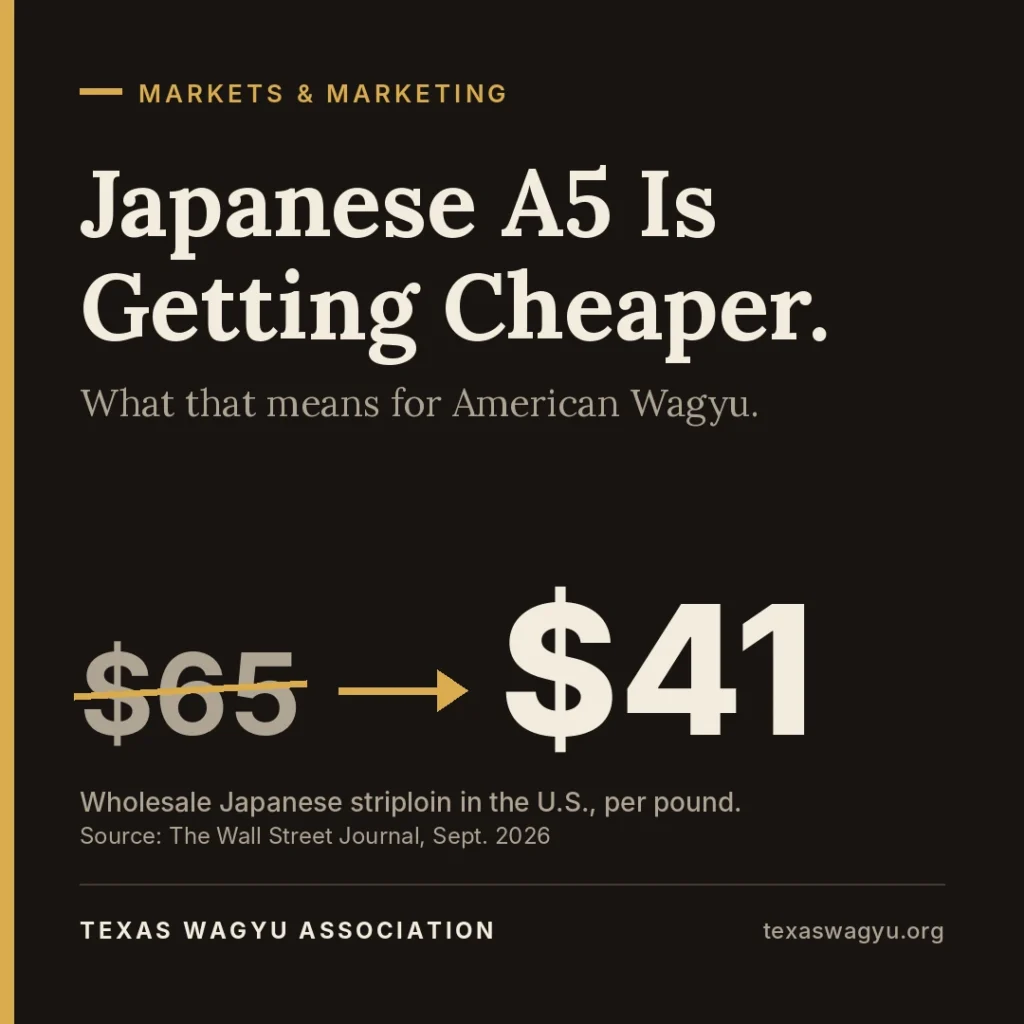
The Wall Street Journal reported in September that the wholesale price of Japanese Wagyu striploin in the U.S. has fallen from about $65 a pound to about $41 over the past few years. That’s a drop of roughly 37 percent.
Three things are behind it:
- More supply in Japan. Japan is producing more Wagyu than its own shoppers are buying, so more of it is headed overseas.
- A weak yen. When the yen is down against the dollar, Japanese beef costs American buyers less.
- More importers. There are more U.S. companies bringing it in and distributing it than there used to be, and that competition pulls prices down.
Keep one thing in perspective. That $41 is a wholesale number. At retail, Japanese Wagyu still runs past $100 a pound for a lot of cuts. Nobody is grinding A5 into Tuesday night tacos.
Japanese A5 at $41 a pound wholesale is still nowhere near an everyday steak. It’s a different product for a different occasion.
Why this isn’t the same steak
Americans are learning to eat A5 the way it’s eaten in Japan: a few thin slices off the grill, a piece of sushi, a hot pot. It’s so rich that a small portion is the whole point.
American Wagyu sits in a different spot on the table. It’s the steak you can eat a whole one of. It has the marbling and tenderness the breed is known for, with the beefy flavor Texans grew up on. A customer who tries A5 at a restaurant on Saturday can still want an American Wagyu ribeye on the grill next weekend. One doesn’t replace the other.
The real issue is the word “Wagyu”
Here’s where it gets interesting for us. The more Japanese beef Americans see, the more questions they ask. Is this real Wagyu? Where is it from? What percent?
That’s fair. The word gets stretched. A fast-food “Wagyu” burger a few years back turned out to be a blend of American Wagyu and regular beef. Stories like that are why some folks online will tell you American Wagyu is fake.
It isn’t, and now there’s a way to prove it. The American Wagyu Association built its Authentic Wagyu program with USDA to back up the claim on the label. Cattle have to meet the association’s live animal standards, which for Fullblood and Purebred means registration and DNA parent verification to both sire and dam. On the rail, beef in the program has to grade U.S. Prime with marbling of Moderately Abundant or higher. Vermont Wagyu shipped the first beef under the Certified Authentic Wagyu label in September 2025, and Real Kansas Meats is among the first packers licensed under the program.
As more Japanese beef shows up, the word “Wagyu” on a label isn’t enough. Buyers want to know exactly what they’re getting, and producers who can show it will win.
What you can do with this
- Say what it is. Fullblood, Purebred, F1, percentage. Put it on the label, the website and the sale sheet. Clear beats clever.
- Keep your paperwork tight. Registrations and DNA verification are what make a claim hold up. If you sell beef, look at what it would take to qualify for a verified program.
- Sell your own story. Nobody in Kagoshima can tell a Dallas customer they’re welcome to come see the cattle. You can.
- Don’t chase A5. You’ll never out-Japan Japan on price or marbling score, and you don’t need to. Sell the steak you raise for what it is.
- Teach your customers. A short note on how to cook it and what the percentages mean goes a long way. Informed buyers come back.
The bottom line
Cheaper Japanese A5 means more Americans are tasting Wagyu for the first time. That’s more people who now know what great marbling tastes like, and plenty of them are going to want it more often than a $100-a-pound steak allows. That’s where Texas Wagyu comes in.
The Texas Wagyu Association helps members breed better cattle and market better beef. Join us today.
Sources
- Japanese wagyu prices drop 37% in US as supply grows, yen weakens, Herald Business (Korea), citing The Wall Street Journal, Sept. 23, 2026
- Vermont Wagyu first to use USDA-Certified Authentic Wagyu label, Drovers
- Real Kansas Meats becomes licensed Authentic Wagyu partner, American Cattlemen
- AWA live animal specification, USDA Agricultural Marketing Service
- Yen depreciation drives Japanese beef exports, Beef Central