
Most of us are pretty good at eyeballing a calf. But “pretty good” gets expensive when that animal is going to be on feed for a long time and its beef sells by the pound. A recent article in American Cattlemen makes the case that a set of scales may be one of the most useful tools on a ranch that sells beef direct. In “Could On-Farm Scales Leverage New Direct Beef Markets?,” writer Jessica Graham ties two things together: a direct-to-consumer beef market that keeps growing, and the weight records it takes to serve that market well.
What the article says
Graham starts with the market. Demand for beef bought straight from the ranch took off during COVID-19, and producers ran into trouble finding processing and ways to reach customers. She then points to two bills in Congress, the DIRECT Act of 2025 and the New Markets for State-Inspected Meat and Poultry Act. Both would open up sales of state-inspected meat across state lines. Neither has passed, and neither would allow selling uninspected beef.
The rest of the piece is about the scales. Graham lists what accurate weights do for you, covers how to choose between fixed, portable and group scales, and looks at how much software you really need. She also describes two products as examples, one that weighs cattle as they drink and one you tow from pasture to pasture.
Why it matters in a Wagyu herd
A lot of us already sell direct. Halves, quarters and boxed beef shipped to the customer’s door are a big part of the Wagyu business. If either of those bills becomes law, members who use state-inspected processors could reach buyers in other states. That’s worth keeping an eye on. For now, check with your processor and the state before you ship anything across a state line.
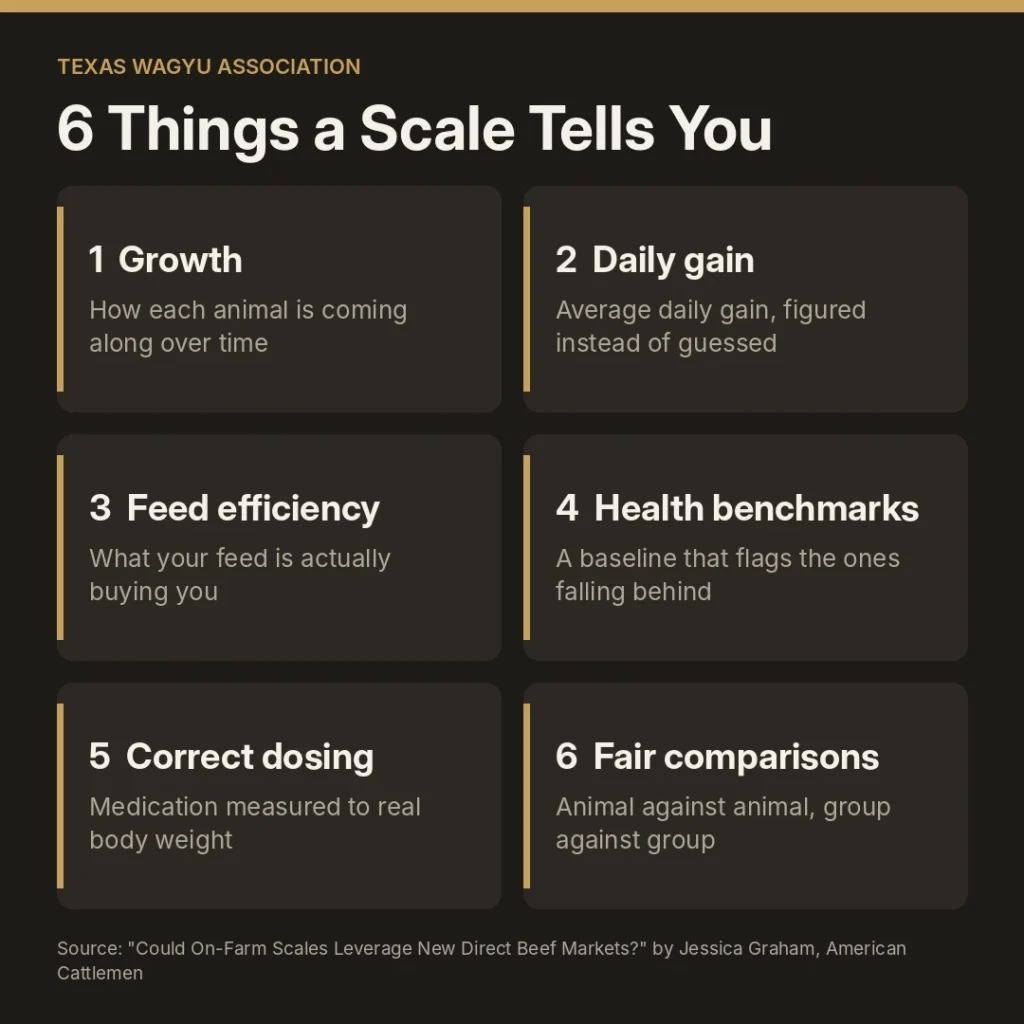
Long feeding periods hide problems. When a steer is on feed for many months, one that has quit gaining can cost you a lot of feed before you notice. Graham notes that regular weights let you figure average daily gain and evaluate feed efficiency. That’s how you catch the one that has stalled.
Dosing by weight protects your investment. The article lists medication dosing among the uses for an accurate weight. Guess low and the treatment may not do its job. Guess high and you’ve wasted product on an animal you’ve got a lot of money in.
Records sell cattle, too. Graham recommends keeping consistent records from birth through harvest to guide breeding, culling, feeding and marketing. For our seedstock members, real weaning and yearling weights are the kind of proof bull and female buyers ask for.
Processing dates are hard to come by. The article points out that weight data helps you plan processing dates and track cattle as they near market weight. If your processor books up months ahead, knowing which steers will be ready, and when, is money in the bank.
Picking a scale that fits
Graham’s advice comes down to buying for the way you actually work:
- Think about where you handle cattle. A fixed scale suits one set of pens. A portable one makes sense if you work several pastures.
- Match it to your herd size. Group systems cut labor for bigger herds. A small herd may only need a platform under the chute.
- Buy only the software you’ll use. A basic readout may be plenty. If you’re chasing performance data, look for a system that stores each animal’s record and figures gain for you.
- Check your accuracy. She cautions that portable scales need to be verified, especially on uneven ground.
Read the full article
Graham goes into more detail on the pending legislation and the equipment than we have room for here. You can read “Could On-Farm Scales Leverage New Direct Beef Markets?” by Jessica Graham at American Cattlemen.
With a Texas Wagyu Association membership, you receive a complimentary annual subscription to American Cattlemen magazine. Join us today and stay current on what’s working for cattlemen across the country.